In shortShoot video rather than stills, because flash is switched off before entry on the Keauhou boats and phone neck lanyards are not permitted. Hold the lit float with your legs flat behind you, never swim after a ray and never touch one. Keep the light source beside or behind you, frame the silhouette crossing the beam, and clean your lens before you get in.
about 45 minutesat the surface filming
about 6 metresmaximum depth below you
around 12 feettypical reef manta width
$500 to $10,000fines for touching a ray
The rules that come before the camera
Flash goes off before you enter the water. A Keauhou operator welcomes underwater cameras on its manta trips on that condition alone, refuses phone neck lanyards, and tells guests never to touch a ray. No piece of kit gets you around those three points.
Lanyards are refused because of what happens on the float line. A reef manta rolling up into the light passes within a hand's width of the surface, and anything dangling from your neck sits in its path. Use a wrist strap instead, or clip the camera to the handle of the flotation device or manta board the crew hands you. That way the camera stays with you when you let go of it to hold the float with both hands.
The operators' conservation wording doubles as your shooting stance. Observe only. Keep your legs horizontal at the surface and keep your hands off the animals. You do not reposition yourself to intercept a ray, you do not kick down for a lower angle, and you do not follow one out of the beam. The close-up you get by reaching is also an offence: in state marine waters it is illegal to capture, take, possess, abuse or entangle a ray, on a penalty scale that climbs from $500 to $10,000.
One more thing to check before you pack: full-face snorkel masks are refused on some of the boats working out of Keauhou Bay, and no camera mount bends that rule.
| On the float line | What applies |
|---|
| Underwater flash | Off before entry. A Keauhou operator makes that the condition for bringing a camera at all |
|---|
| Neck lanyard for a phone | Not permitted |
|---|
| Wrist strap, or clipped to the float or manta board | The workable alternative; one tour on this site hands you dive lights with a manta board to hang onto |
|---|
| Touching a manta | Never. State marine waters law treats capture, taking, possession, abuse or entanglement of a ray as an offence, penalised from $500 up to $10,000 |
|---|
| Moving to intercept a ray | No. Observe only, with your legs horizontal at the surface |
|---|
| Full-face snorkel mask | Refused on some Keauhou boats |
|---|
Manta ray night snorkel photography tips for one cone of light
Shoot video and pull your stills from it later. Without flash, a single frame in black water almost never holds together, while video keeps rolling through the one or two seconds when a manta actually fills the beam. Everything else in these manta ray night snorkel photography tips follows from that choice. Treat the session as one continuous scene and let the editing happen at home, where you can scrub through a pass frame by frame.
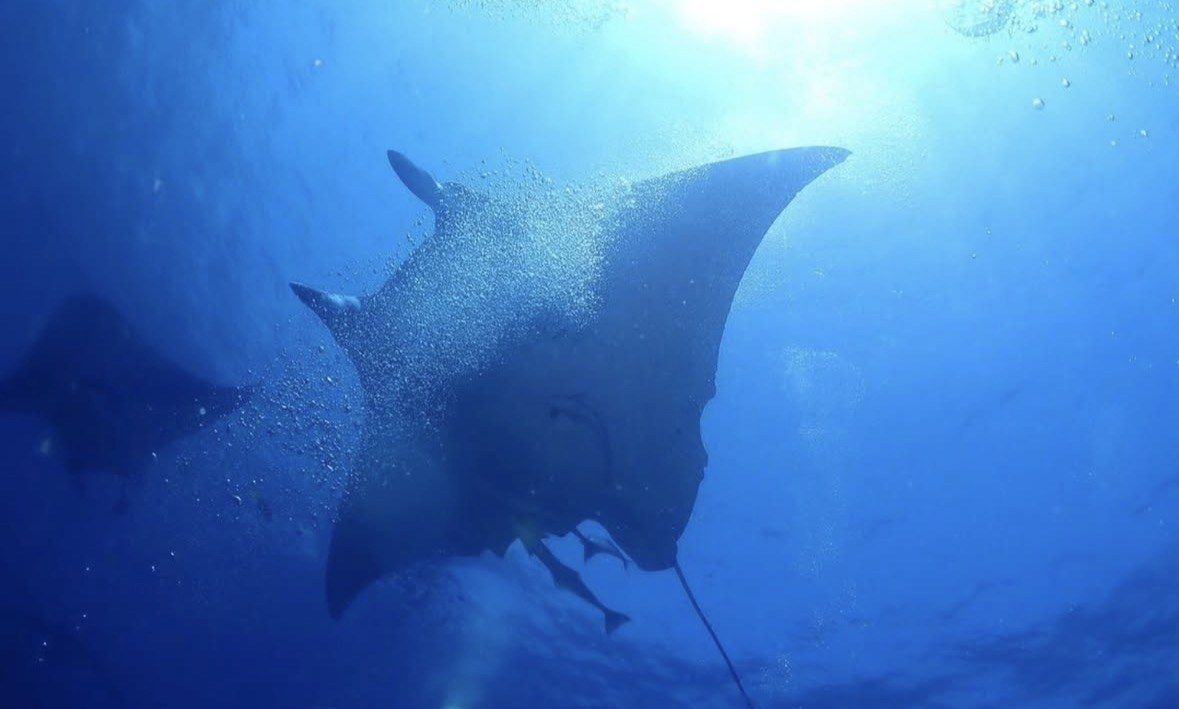
Hold your position and let the animals come. Your subject is drawn to the lighting rig rather than the reverse: the floodlights above the bay gather plankton near the surface, the rays loop up through it to feed, and the feeding sits in the water immediately beneath the float line you are holding. The water is shallow here, about 6 metres at its deepest, so little takes place out of your view.
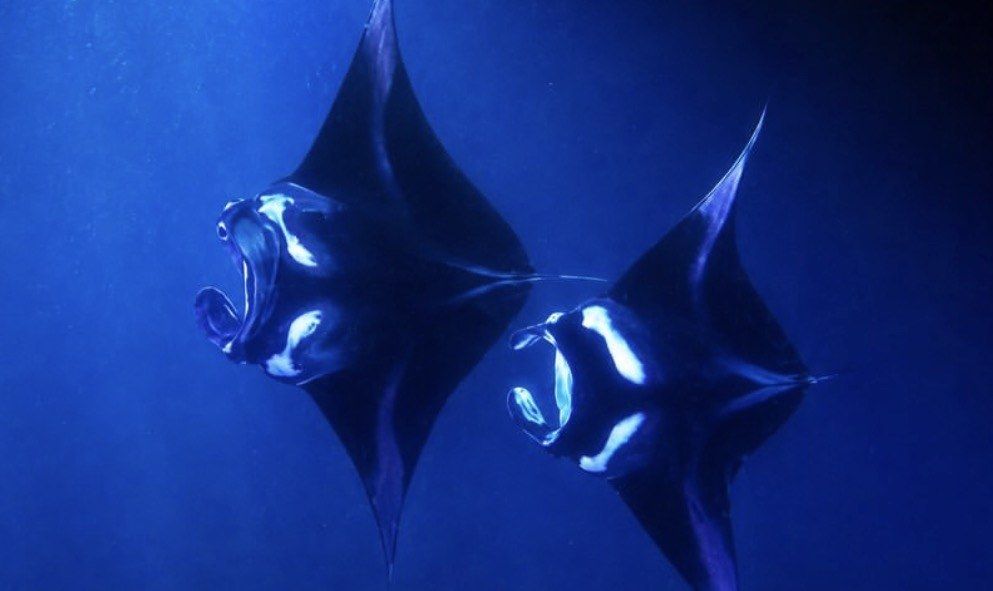
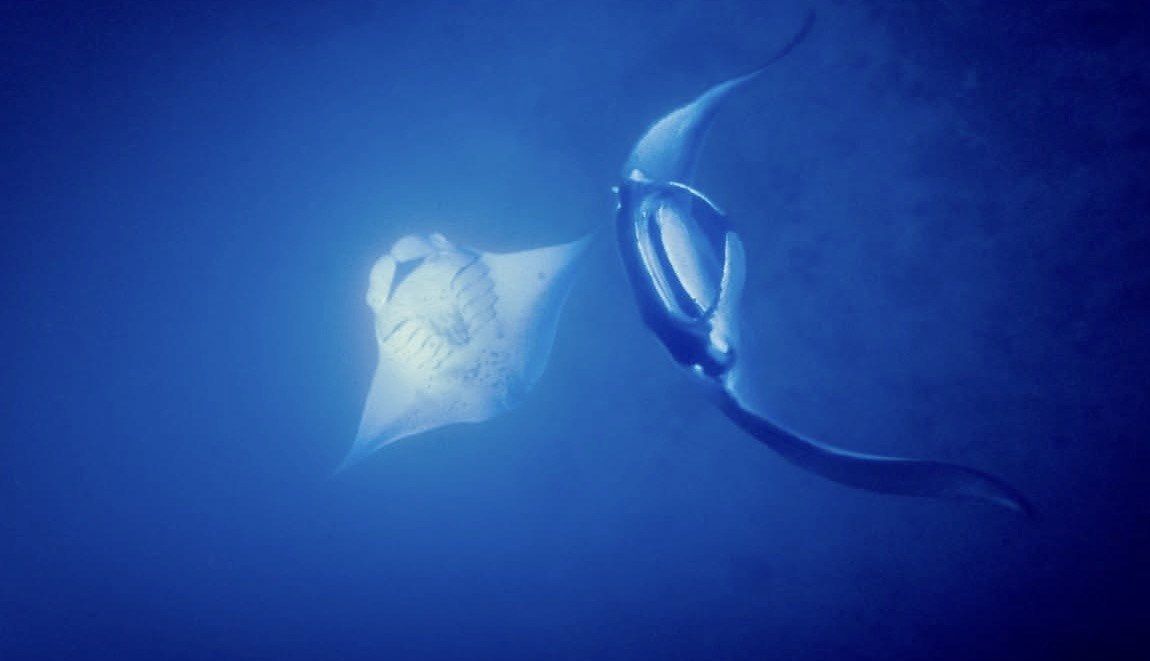
Light placement decides whether the footage is usable. Keep the beam going away from you, with the light source beside or slightly behind your shoulder, so the lit water sits in front of your lens instead of firing back into it. Then wait for the ray to cross the cone: a wing edge entering the light, the white belly turning through it, the animal dropping back into black. Drifting off the float line to chase a pass that is already ending costs you the next five.
Backscatter is unavoidable, so plan around it. The plankton that draws the rays hangs right where you are filming, and your footage will show drifting specks like snow. Shoot across the beam rather than straight down it, and keep your own light off the lens axis.
Clean the glass on the boat before entry. Sunscreen film and one fingerprint turn every point of light into a smear under the beams. Rinse the port, wipe it dry, then keep your fingers off the front.
- Start recording once you are settled on the float, with both hands already in place
- Keep both hands on the float where you can and let one hold the camera out, slightly to the side
- Film wide and let the manta come to you instead of zooming
- Hold a shot for several seconds after the animal leaves the frame; the second pass is often immediate
- Expect your best few seconds to be a silhouette crossing the edge of the beam
- Look up from the screen regularly: the rays pass closest when you are not watching a viewfinder
The longer evening, gear included
The 2.5-hour Big Island Manta Ray Night Snorkel, from $138 and rated 4.8 ★ (6332 reviews), covers the snorkelling gear, a jacket-style wetsuit top and a flotation device, and lists GoPro rental as an extra outside the fare, subject to availability, so you can film without hauling your own kit to Hawaii.
★ 4.8/5 · 6,332 reviews
GoPro settings for a manta ray night snorkel, and phones in a housing
Set the camera up on the drive down; fiddling on a dark deck wastes the briefing. Video mode, the widest field of view you have, digital zoom off, front light and strobe off. Lock exposure and white balance if the camera allows it. On automatic, both hunt between the warm beam and the black water around it, and the brightness flickers for no reason.
Frame rate matters more than resolution at night. A lower frame rate gives each frame more light, so pick the slowest option you are comfortable with and leave high frame rate slow motion for daylight. Stabilisation earns its crop while you hang on a float that the swell keeps nudging. Colour filters do nothing in the dark, so leave the red filter at home along with anything else that bolts onto the front of the housing.
Battery behaviour catches people out. You are running continuous video for a surface session of roughly 45 minutes, in water that peaks near 80 F at the warmest point of the year and still sits below body temperature, and a cool housing with a camera recording flat out drains faster than the same camera on a sunny deck. Start fully charged, carry a spare you can swap on the boat, and bring a card with more room than you think you need, because deleting clips at the surface is how people miss a pass.
Phone housings are the weak link. Apple rates recent iPhone models as IP68 to a maximum depth of 6 metres for up to 30 minutes, a controlled laboratory figure and shorter than your time in the water. Use a sealed housing rated for snorkelling, and accept that whatever you take in is your own risk. Close it somewhere cool and dry; a housing sealed in a hot car fogs on first contact with the sea.
Dim the screen to its lowest usable level and kill the beeps and status lights before entry. Other guests are watching the same cone of light a metre away, and a lit screen in their eyeline ruins it for them.
When to stop filming and let the crew's lights do the work
The lighting rig belongs to the crew. Their dive lights and lit floats create the scene, and on charters carrying divers too the dive lights sit roughly 30 feet below the snorkelers' raft, lighting the column from underneath. Where you float in relation to them beats any menu setting.
Letting someone else shoot is a legitimate plan. One Keauhou operator includes photos from the night in its manta snorkel, and the 2.5-hour trip on this site lists GoPro rental among the extras that sit outside the fare, subject to availability, so you can turn up with nothing in your hands and still go home with footage. Film the first half of the session and watch the second half with nothing between your mask and the animals; the number of clips worth keeping stays about the same.
Your chances of having something to film are good without being certain: the operators working Manta Village report rays on more than 90% of nights, and not one of them will promise you an animal in front of the lens. The animals feed within a couple of metres of your chest, and most reef mantas off Kona measure around 12 feet across, a scale a wide-angle lens flattens badly. Watch part of the session with the camera switched off.
Where to float for a clear line of sight
Crowding is what ruins footage here. The state estimates 60 to 70 manta viewing vessels work the two Kona sites, and the rules that would cap permits, passenger numbers and guide ratios are still draft, so nothing limits how many floats end up over the same patch of lit water. Fewer people on your line means fewer fins and arms in the frame.
Two things are inside your control. Pick a Keauhou Bay departure: the boats are above the lit water in about five minutes, against the 45-plus minutes each way a northern harbour costs, which leaves more of the evening for filming. Then take the smallest group you can get on. A later, after-dark slot is sold on fewer vessels at the site and darker water, and darker water gives your camera stronger contrast between the beam and everything behind it.
For filming, the small-group departure listed on this site is the compact option: 1 hour, from $145, rated 4.8 ★ (1184 reviews), with a guide, equipment, an optional wetsuit and beverages inside the fare, and a short format that keeps the float line thin. Check-in falls 30 minutes ahead of departure at Keauhou Harbor, by the boat dock, where the crew stand beside a white van with lights on the roof, and that half hour is the window for anything you still need to do to the camera. Spaces at the pier run out, and the fallback is Kaleiopapa Street, 3 to 5 minutes on foot down to the water, carrying the housing rather than working on it. Do the camera setup before you lock the car, with the housing closed and the card in.
Questions people ask
Can you bring a camera on the manta ray snorkel?
Yes. A Keauhou operator says underwater cameras are welcome provided any flash is turned off before you enter the water, and the same operator does not allow neck lanyards for phones. Use a wrist strap or clip the camera to the float you are holding. One tour on this site also lists action camera rental as an extra outside the fare, subject to availability.
Does the later, darker departure give better video?
It usually does. The after-dark slot at Keauhou is marketed on fewer vessels at the site and darker water, and darker water means stronger contrast between the lit cone and the background. The trade-off is a shorter evening, about 1.5 to 2 hours against 2 to 2.5 for the earlier trip, and that late slot only opens once the first one fills, so it may not be on the schedule for your date.
Should I try stills at all?
Shoot video and extract frames instead. With flash switched off and a single moving light source, the only consistently sharp stills you will get come from footage you can scrub through afterwards. If you insist on stills, hold burst mode down while a ray crosses the beam.
Can I bring my own dive light or video light?
The published camera rules at Keauhou cover flash, lanyards and contact with the animals, and no operator page sets out a permitted output for guest lights. The crew supply the lighting, with dive lights and lit floats on the boats, so ask on the night before adding anything of your own and keep it out of other guests' eyes.
Is my footage of any use beyond my phone?
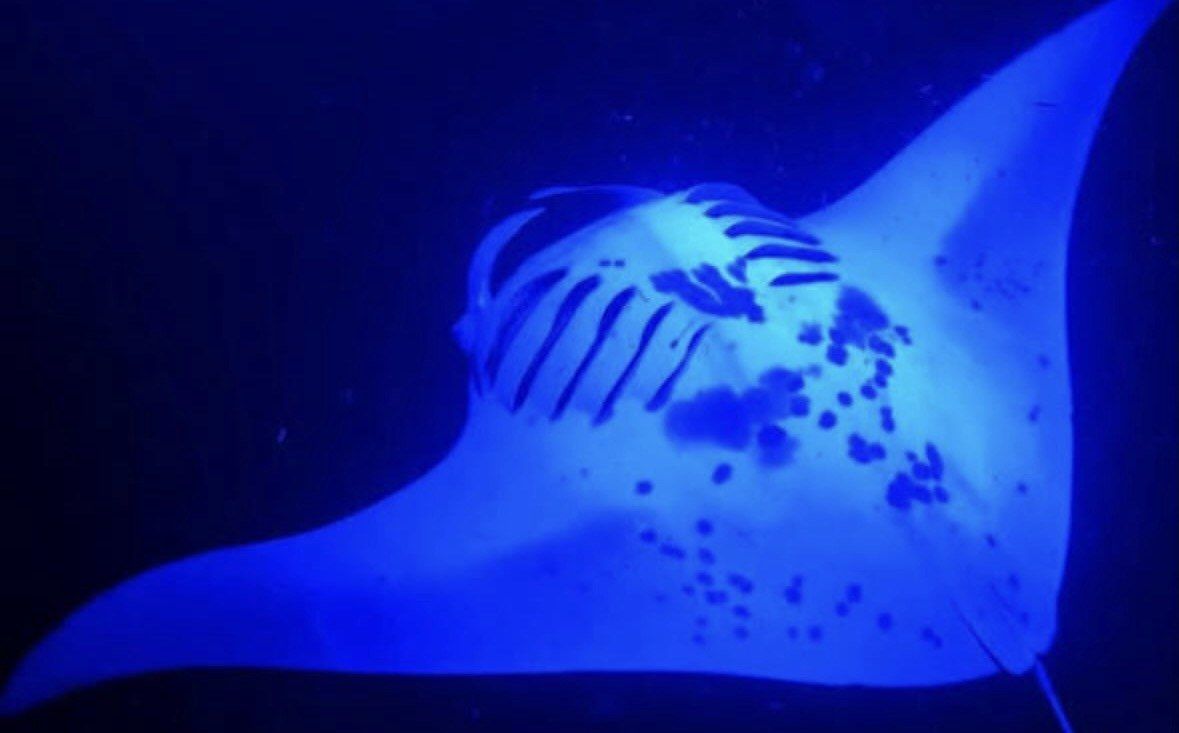
A frame of a belly works like a fingerprint, since the spot pattern is what researchers read to tell one ray from another. The Manta Pacific Research Foundation, based in Kona, has put names to more than 300 of the local animals that way, and the photo-identification records held by NOAA Fisheries cover 318 individual reef mantas around Hawaii Island going back to 1979. A clean, well-lit pass of a belly can therefore be matched to a named animal. Mention it to the crew if you think you have one.
Read also