In shortThe animals at the Keauhou night site are reef manta rays, and most of those seen off Kona measure around 12 feet across. Laser photometry measured the well-known Kona manta Bertha, first identified in 1992, at 11.7 feet from wingtip to wingtip. The far bigger giant manta ray reaches 26 feet and is ESA-listed as threatened, but it is only an occasional visitor.
~12 feettypical reef manta off Kona
11.7 feetBertha, laser measured
26 feetgiant manta maximum width
300+named Kona mantas
How big are manta rays in Hawaii
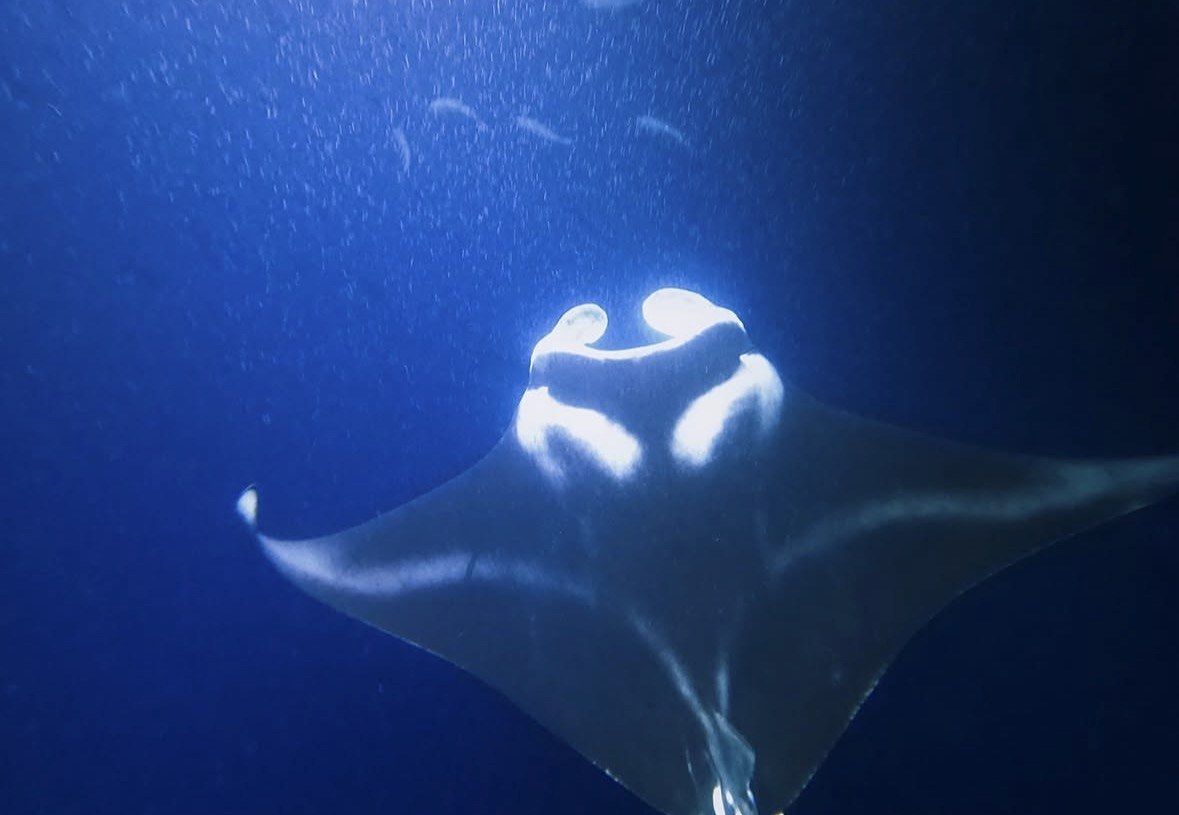
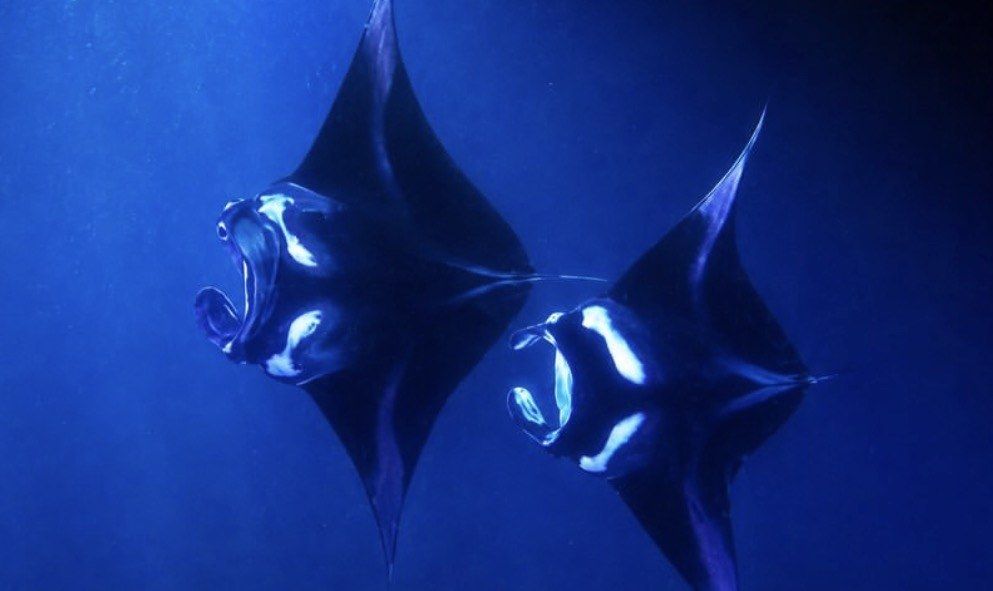
Most reef mantas seen off the Kona coast measure around 12 feet across, wingtip to wingtip. That is the figure to hold in your head on the boat ride out, because it is the size of the animal that will pass under your chest once the lights are on and the plankton thickens.
The water helps you judge it. The snorkel area at Keauhou is shallow, about 6 metres at its deepest, so a 12-foot ray banking up through the beams fills most of what you can see from the float line. Nothing happens far below you and out of view.
Giant manta ray vs reef manta: what you are actually looking at
Hawaii has a second, much larger species. NOAA Fisheries puts the giant manta ray at a disc width of up to 26 feet and lists it as threatened under the Endangered Species Act. It turns up on this coast as an occasional visitor rather than as the animal the night site is built around.
The residents at Manta Village are reef mantas, which is why the numbers stay consistent from night to night. Hawaii state law protects rays of any kind in state marine waters: capturing, taking, possessing, abusing or entangling one is illegal, with fines escalating from $500 to $10,000.
| Feature | Reef manta ray (resident at Manta Village) | Giant manta ray (occasional visitor) |
|---|
| Disc width | Most seen off Kona around 12 feet | Up to 26 feet |
|---|
| Role at the Keauhou night site | Resident animals, which is why trips run all year | An occasional visitor to this stretch of coast |
|---|
| Protection in the facts cited here | Hawaii law bans capturing, taking, possessing, abusing or entangling any ray, fines $500 to $10,000 | ESA-listed as threatened |
|---|
Big Island Manta Ray Night Snorkel
This 2.5-hour trip, from $138 and rated 4.8 ★ (6332 reviews), includes live commentary on board along with snorkelling gear, a jacket-style wetsuit top, a flotation device, bottled water and light snacks, so the natural history gets explained before you are floating over the lights.
★ 4.8/5 · 6,332 reviews
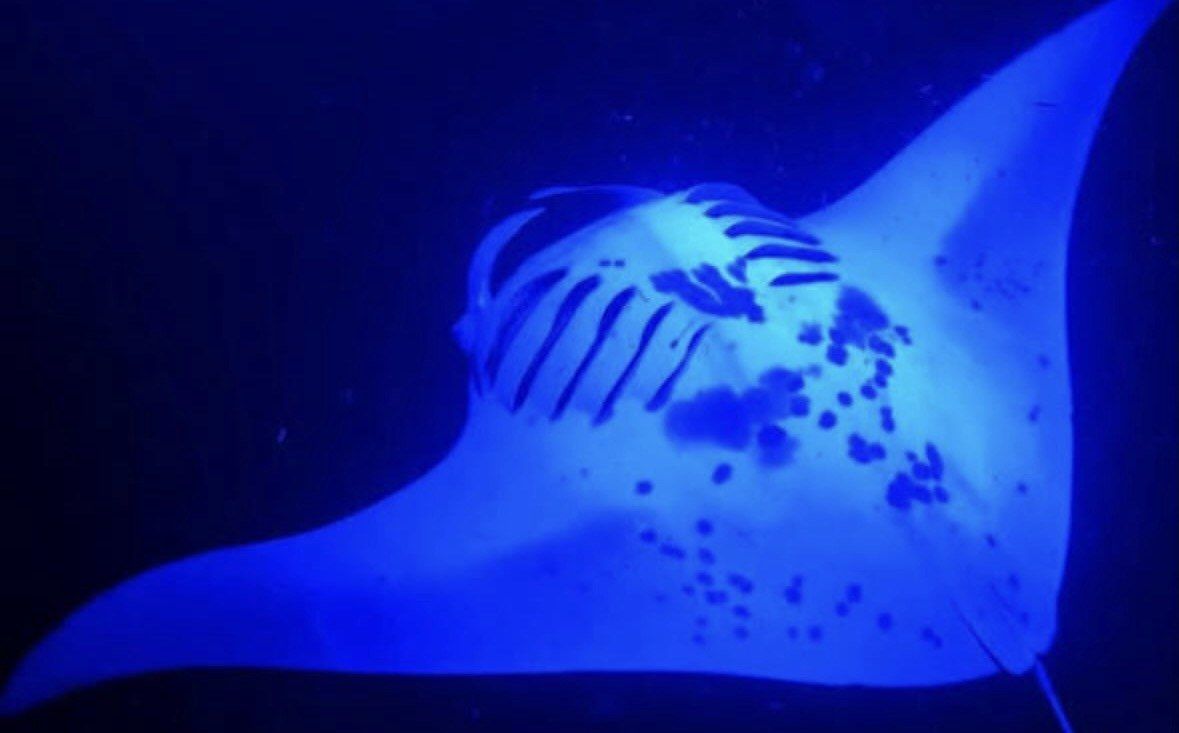
Belly spots work like fingerprints
Every reef manta carries its own pattern of dark spots on its white underside, and that pattern is what researchers read instead of a tag. The Kona-based Manta Pacific Research Foundation has identified and named more than 300 individual mantas in local waters from those belly patterns.
The record goes back decades. NOAA Fisheries holds photo-identification records of 318 individual reef manta rays around Hawaii Island since 1979, and about 600 in Maui Nui since 2005, with no photo-ID matches between the two groups.
Bertha is the best-known animal in the Kona catalogue. She was first identified in 1992, and laser photometry measured her at 11.7 feet from wingtip to wingtip, slightly under the 12 feet quoted as typical for the rays seen here.
Plankton, floodlights and the barrel roll
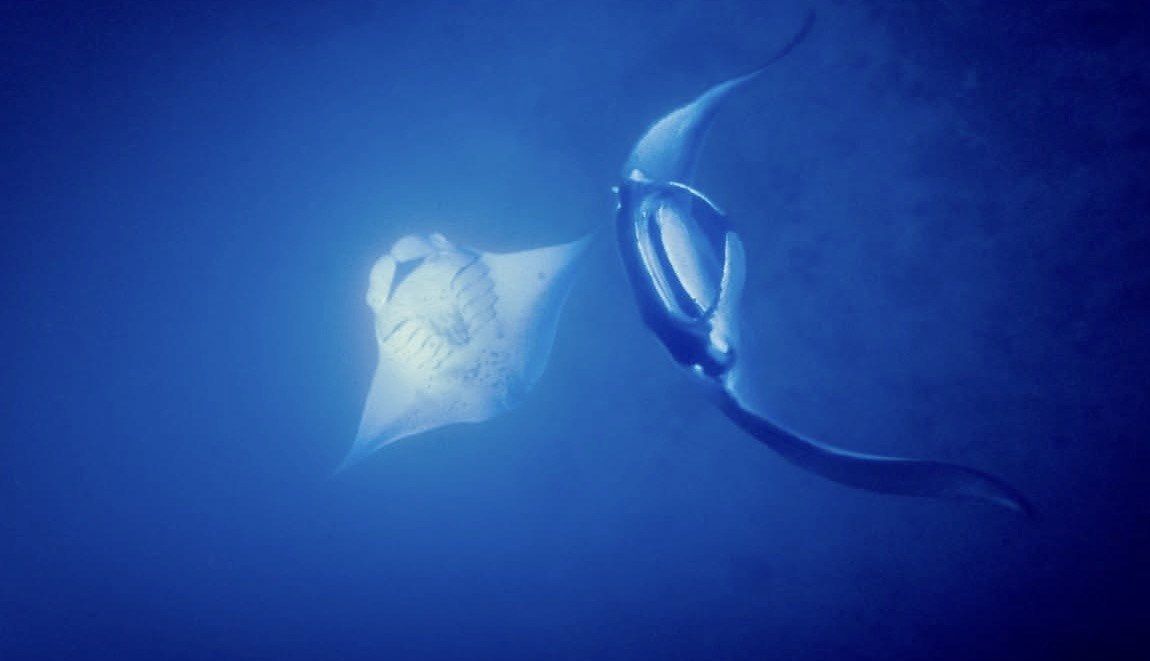
Mantas gather off Keauhou to feed on microscopic plankton, according to the state tourism authority. They are filter feeders working a moving food cloud, so their behaviour tracks the densest water rather than any clock.
The aggregation is man-made in origin. Floodlights aimed at the ocean by the resort above the bay in the early 1970s set the chain going: plankton collected in the beams, and filter-feeding rays found a concentration of food worth coming back for. That is the whole mechanism behind the attraction and the reason boats carry dive lights and lit floats.
Where the plankton is thickest, a manta stops swimming in straight lines and loops. The barrel roll is a feeding move: the animal turns a tight somersault to stay inside the same patch of food, mouth open, and repeats it. In 6 metres of lit water that happens directly beneath the snorkelers.
Why the same animals come back to Manta Village
There is no manta season at Keauhou. Residency explains it: the rays feeding in the lights are not migrants passing through on a schedule, which is why boats work every month of the year and why operators at Manta Village put rays in the water on more than 90% of nights without turning that into a promise.
That reliability comes from site fidelity, and the genetics back it up. NOAA Fisheries describes Hawaiian reef mantas as isolated island-resident populations, with movement between island groups estimated at roughly one female every 1,300 years and one male about every 64 years. These animals stay home.
The populations are small and replace themselves slowly, which is why identification work matters. Genome scans cited by NOAA Fisheries estimate about 104 adult breeding reef mantas on Hawaii Island and 129 across Maui Nui.
- Reef mantas in residence year-round, which is why no month counts as a peak
- Rays present on more than 90% of nights by the operators' own count at Manta Village, with no promise attached
- 318 individual reef mantas photo-identified around Hawaii Island since 1979
- More than 300 named individuals in the Manta Pacific Research Foundation catalogue
- About 104 adult breeding animals estimated on Hawaii Island
Reporting a sighting with your own photographs
A clear frame of a manta's underside is the one souvenir with scientific value, because the whole Kona catalogue of named individuals was built from belly spot patterns. Shoot straight up at the belly as the animal rolls, keep the spots between the gills in frame, and ask the crew where identification photographs are sent before you pack your camera away.
The rules on the water are strict and they exist for the animals. Conservation guidelines from the operators put you in the role of observer with your legs held flat at the surface, which keeps any part of you from reaching a ray and happens to be the steadiest position for shooting upward. Underwater flash photography is banned on at least one Keauhou boat, along with Shark Bands and neck lanyards for phones, and nobody touches a manta.
Questions people ask
Do manta rays sting or bite?
Mantas at the Keauhou site feed on microscopic plankton, filtering it from the water rather than hunting. The in-water role is observation only under operator conservation guidelines, with your legs kept horizontal at the surface so nothing of yours reaches a passing ray. Rays in state marine waters are protected under Hawaii law against capture, taking, possession, abuse and entanglement, and the fines escalate from $500 to $10,000.
How many reef mantas live around Hawaii Island?
Genome scans cited by NOAA Fisheries estimate about 104 adult breeding reef mantas on Hawaii Island, and describe the population as only a few hundred individuals. Belly spot patterns have let the Kona-based Manta Pacific Research Foundation put names to more than 300 of those individuals in local waters. The same animals circulate between the island's feeding areas.
Are Hawaii's reef mantas found around other islands?
NOAA Fisheries holds photo-identification records of about 600 reef mantas in Maui Nui since 2005, which it defines as Maui, Molokai, Lanai and Kahoolawe, with South Maui reefs and Olowalu reef among the gathering areas there. No photo-ID matches have been found between the Hawaii Island and Maui Nui animals. A statewide survey is under way to find aggregation areas on other islands.
Is there a time of year when the mantas leave?
No. The rays at the Keauhou night site are resident, so there is no manta season and the boats work every month. The track record quoted by Manta Village operators runs above 90% of nights with rays present, which none of them turns into a guaranteed sighting.
How close do the mantas come to snorkelers?
Close enough that the no-touch rule is the first thing crews explain. There is not much water under you, roughly 6 metres at the deepest point of the snorkel area, and the plankton concentrates in the lit surface layer, so the rays rise into it to feed. Guests hold a lit float with their legs flat behind them and let the animals pass underneath.
Read also